

Mindful Walking in an Italian Piazza: A Tourist-Free Practice
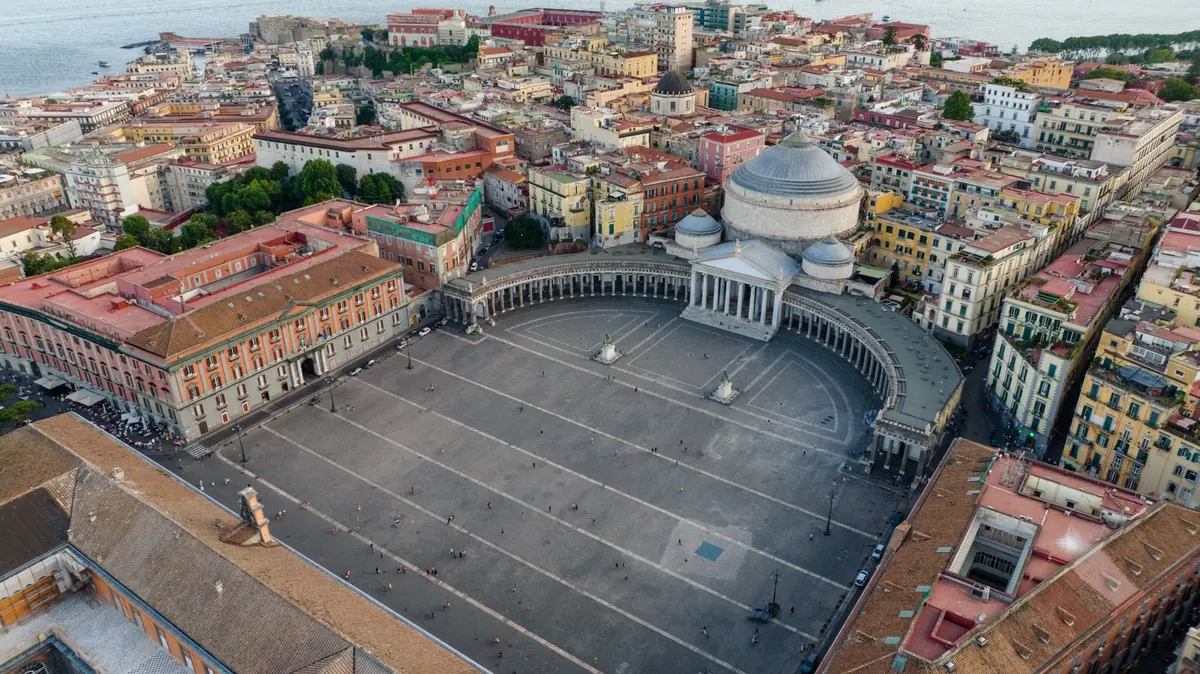
Most visitors cross a piazza the way they cross a road: eyes on the far side, camera in hand, already thinking about the next stop. That is a shame, because a square in a small Italian town is one of the few places in Europe designed for exactly the opposite behaviour. It was built for loitering. For standing in the shade. For watching who comes out of the church, who sweeps their step, who orders the second coffee.
Mindful walking there does not require a mat, a course or a special vocabulary. It needs an hour when the light is low, a pair of soft shoes, and the willingness to move at roughly half the speed you think is normal. What follows is a practical guide, whether you live three streets away or arrived by bus this morning.
Why a piazza rewards slow walking
Old squares are bounded spaces. You can see the whole of one in a glance, which means your attention has nowhere urgent to go. The perimeter gives you a natural circuit. The stone underfoot changes from smooth slabs near the church to rougher cobbles at the edges. Sound behaves strangely: footsteps return to you from the facades, and a single voice carries across the emptiness.
This makes a piazza unusually generous to anyone practising attention. There is enough going on to keep you curious and little enough to keep you calm. A busy street demands vigilance. A quiet square invites you to slow down and notice the small things: the shadow line moving across the paving, the tin bucket beside the flower seller's van, the smell of soap from a doorway that has just been washed.
Choose the square and the hour
In tourist towns, the main square is at its best before eight in the morning and after eight at night. Between those hours it belongs to queues and guided groups. Look instead for the second square, the one behind the cathedral or down the hill from the post office, where the bar still opens for the men who have been up since five.
A few things worth checking before you go:
- Fountain or no fountain. Water gives you a steady, repeatable sound to return to when your mind drifts.
- Two or three exits. Squares with only one way in feel enclosed in a way that can be uncomfortable if it fills up.
- Shade at the hour you plan to walk. The best route usually follows the shade, not the sun.
- A bench or low wall. You will want somewhere to stop without feeling you have to buy something.
- Church bells. In many small towns they still mark the hour. It is a useful way to keep track of time without checking your phone.
Sunday morning is often quieter than Saturday, and market day is best avoided entirely unless you want a busy practice.
Begin with three minutes of standing still
Walk to the centre of the square, or to whatever point feels slightly exposed, and stop. Put your bag down if you have one. Let your eyes rest on a single thing — a shutter, the base of a lamppost, the edge of the fountain — and stay with it.
Then widen out. Feel the temperature on the back of your neck and the difference between the sunlit side and the shaded one. Notice that your weight has settled into both feet. After a minute or so, take a breath that is slightly longer than usual, and let it go without ceremony.
Standing still in a public place is a small act of courage for most of us. It gets easier the second time.
If you feel self-conscious, remember that people in Italian squares are used to seeing other people do nothing at all. You are not conspicuous. You are doing what the square was built for.
Walk the perimeter with three anchors
Now walk once around the edge, close to the buildings rather than through the middle. Move at a pace that would feel a little strange if someone were walking beside you. Try to feel each foot meeting the ground: the heel first on flat slabs, the whole sole on cobbles.
The fountain
Stop when you reach the water and listen for a full breath in and out. Notice that the sound is not uniform — there is the splash, the trickle underneath it, the echo off the stone behind. Listen for the echo.
The bar doorway
Smell the coffee and the pastry, hear the cups being stacked, and allow yourself to imagine one small detail: the handle of the cup, the spoon on the saucer. Do not go in. Keep walking. That is part of the practice.
The shaded edge
Find the line where the shadow of the buildings falls across the paving and stand with one foot on each side. Feel the difference. Do it once more slowly. This small experiment will hold your attention better than any instruction to "be present".
Prompts for visitors
If you are only in town for a day or two, keep the practice short and repeatable. Ten minutes is plenty.
- Arrive ten minutes before you plan to leave, and spend the first three minutes standing still.
- Choose one sound and follow it until it disappears — footsteps, a scooter, a bird under the eaves.
- Walk two sides of the square, then sit on a step and do nothing at all for a minute.
- Before you go, name three things you would not have noticed at normal walking speed.
One caution about photography: taking a picture can be a way of leaving the moment rather than entering it. If you want the image, take it at the end, after the slow walking is done.
Prompts for residents
Living nearby changes the practice. Familiarity makes it easy to stop looking. Use the square as a daily reset rather than an event: on the way to the bank, on the way back from the school run, or in the half hour before the evening passeggiata begins. Cross it in the early morning when the street cleaner is still out and the shutters are coming up, and you will see things you have walked past for years. The plaque on the wall you have never read. The way the light hits the arcade at the same hour each April.
Residents have one advantage over tourists: they can go when it is raining. An empty square with wet stone and a few umbrellas is one of the finest places in Italy to walk slowly, and almost nobody does it.
When the square is busy
Some afternoons the piazza will be full and the practice will be harder. That is fine. Keep a smaller circuit, stay near the edge, and let the noise be part of what you notice rather than an obstacle to overcome. If it is too much, leave. Mindfulness does not require endurance. Choosing a quieter hour next time is not failure — it is good planning.
A short practice to take home
You can repeat the essential structure anywhere: stand still for three minutes, walk one slow circuit, stop twice to listen, and finish with a single minute of not doing anything. It works in a supermarket car park and in a hospital corridor.
If you are managing pain, a balance problem or a heart or lung condition, keep the walking short and check with a doctor or physiotherapist about what is sensible for you before adding longer sessions. Mindful walking is gentle, but it is still walking.
Do not worry about doing it well. The square is not going anywhere, and tomorrow morning at seven it will be quiet again. Go and stand in it for a few minutes, and let the rest follow from there.
Photo: K / Pexels